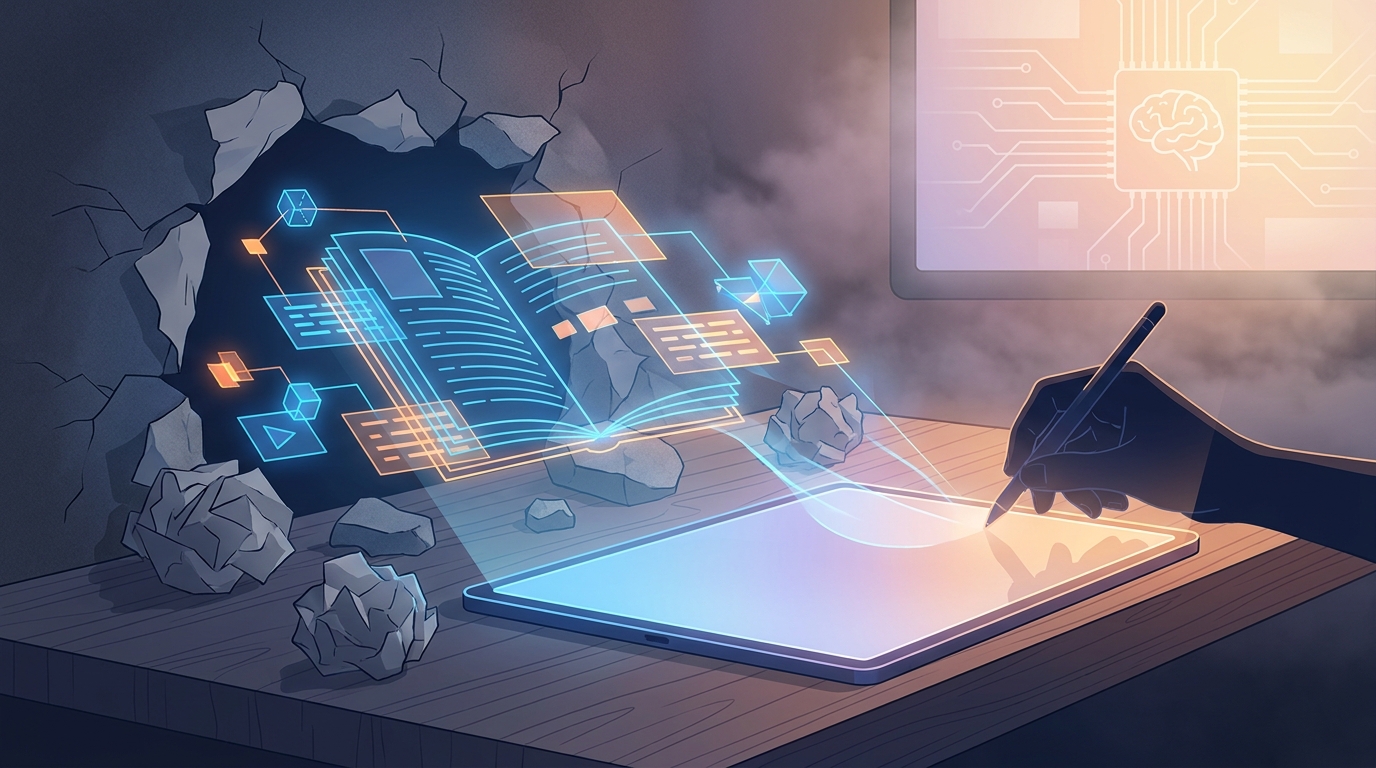
“I know the inciting incident and I know the climax, but Chapter Four feels like an insurmountable wall.” This sentiment haunts countless novelists. The blank page rarely intimidates because of an absence of imagination; rather, it paralyzes because of an overwhelming distribution of narrative weight. Between maintaining consistent character agency, advancing secondary subplots, and pacing scenes to adhere to an overarching three-act dramatic arc, the cognitive load can derail even seasoned writers before the second act begins.
For novelists seeking to bridge the gulf between abstract concepts and structured narrative blueprints, understanding Breaking the Block: How NovelWithAI Turns Blank Pages into Chapter Outlines provides a craft-first blueprint for sustainable writing momentum.
The Craft Friction: Structural Collapse and the Pointer Problem
In classical dramaturgy, whether utilizing the classic Three-Act Structure, the Fichtean Curve, or Dan Harmon's Story Circle, every chapter functions as a microcosm of change. A scene must alter the emotional polarity, test a protagonist’s internal flaw, or shift the strategic balance of the conflict. When novelists stall, it is typically because the structural foundation lacks intermediate causal links—the “therefore/but” progression championed by experienced dramatists.
Standard language models struggle severely in this territory. When tasked with planning or drafting extended narratives, traditional conversational interfaces suffer from severe context degradation. They exhibit what narrative technologists call the “pointer problem”: failing to track which character knows which secret, misplacing key physical items, dropping subplots entirely, or shifting character motivation arbitrarily. Writing a novel is an exercise in state management, and raw statistical text predictors lack persistent state memory.
Architecting the Foundation: The 'Brain to Book' Pipeline
Rather than treating novel planning as an open-ended chatbot conversation, NovelWithAI treats narrative design as a multi-tier engineering problem through its six-step “Brain to Book” pipeline. Instead of forcing writers to manually prompt every beat, the pipeline ingests a single conceptual prompt, existing manuscript excerpt, or high-level premise and translates it systematically into a comprehensive novel architecture in under 60 seconds.
This automated scaffolding pass constructs:
- The Living Story Bible: Canonical world rules, thematic parameters, and setting constraints that govern the universe.
- Multi-Dimensional Character Sheets: Detailed breakdowns of internal flaws, external goals, voices, and psychological stakes.
- 3 to 5 Overarching Story Arcs: Clear segmentation of dramatic tension across the traditional macro-structure (e.g., Setup, Rising Complication, Midpoint Crisis, Climax, Resolution).
- Granular Chapter-by-Chapter Blueprints: Actionable scenes detailing explicit narrative objectives, scene conflicts, and outcomes.
Crucially, this architecture is not static. Authors can selectively edit, regenerate, reorder, or completely rewrite individual chapter blocks without destabilizing the broader narrative envelope.
State Tracking Across Chapters: The Pointer System
The primary barrier to using generative tooling for serious long-form fiction has always been continuity drift. NovelWithAI solves this through a dedicated Pointer System that functions as an intelligent state machine alongside the prose engine. By maintaining an index of established story facts, active plot threads, character inventories, and localized world states, the platform ensures that events in Chapter 14 logically reflect the consequences of Chapter 3.
{
  "chapter_id": "ch_04",
  "active_narrative_threads": ["unsolved_arson_dockside", "clara_distrust"],
  "character_state": {
    "clara": {
      "knows_secret_lineage": false,
      "current_emotional_polarity": -2,
      "inventory_held": ["cipher_wheel"]
    }
  },
  "world_state": {
    "curfew_in_effect": true,
    "dockside_district_access": "restricted"
  }
}
By enforcing this structured context layer prior to prose execution, the platform prevents the narrative inconsistencies that plague generic AI tools. If a character does not yet possess a vital piece of information, the generation pipeline will not accidentally allow them to act on it.
Authentic Cadence: Tackling the “Will It Sound Like Me?” Dilemma
A legitimate concern voiced by serious fiction writers is stylistic homogenization. Out-of-the-box language models default to predictable cadence: balanced tripartite sentences, repetitive introductory clauses, and an overreliance on melodrama. In fiction, voice is character; voice is theme.
To preserve authentic authorial identity, NovelWithAI deploys specialized post-processing layers specifically configured to humanize generated drafts. By deliberately altering syntax length, injecting varied rhythmic pauses, and breaking synthetic symmetrical structures, the engine produces prose that avoids conventional AI detection flags and matches the natural variation of human composition. Writers retain complete creative sovereignty: every generated chapter can be adjusted for tone, polished manually, or used strictly as an accelerated first-pass draft.
Importantly, the relationship remains strictly craft-assistive: all novel architectures, character databases, structural outlines, and generated chapter prose remain 100% author-owned intellectual property. When ready, projects export seamlessly into universal Markdown format for subsequent editing in dedicated environments like Scrivener, Obsidian, or Ulysses. Writers can study deeper craft workflows and workflow integrations on the NovelWithAI blog.
Moving Beyond the Paralyzing Page
Overcoming creative resistance is fundamentally about breaking immense, complex tasks into solvable, tactical units. An unwritten eighty-thousand-word novel is terrifying; a single scene where two characters argue over an ambiguous letter is exciting and actionable. Understanding Breaking the Block: How NovelWithAI Turns Blank Pages into Chapter Outlines allows fiction writers to trade the exhausting friction of organizational debt for structured, disciplined storytelling momentum.
Writers interested in exploring the platform's architectural philosophy can read more on the NovelWithAI about page, design their core story arcs, and replace the blank page with an outline built to withstand the demands of a full-length book.